
by Stephen Judd
Share
Some things are ours to carry. Some things are not.
That distinction matters.
God calls us to be responsible, faithful, and obedient. There are decisions we must make, work we must do, people we must help, and steps of faith we must take. Scripture never presents trust in God as an excuse for passivity.
But neither does God expect us to carry what only He can carry.
We can do our part without trying to do God’s part.
The Bible actually speaks of different kinds of burdens. Galatians tells us to “bear one another’s burdens” and then, only a few verses later, says, “each one shall bear his own load” (Galatians 6:2, 5 NKJV).
There are burdens we should help someone else carry. There are responsibilities that belong to us and should not be shifted to someone else.
And then there are burdens that are simply too heavy for us.
David wrote, “Cast your burden on the LORD, and He shall sustain you” (Psalm 55:22 NKJV). Peter echoes the same truth: “casting all your care upon Him, for He cares for you” (1 Peter 5:7 NKJV).
There comes a point when faith must release what it cannot control.
Sometimes we pray about a situation and then immediately pick it back up. We rehearse every possibility, imagine every outcome, and try to solve problems that have not even happened yet. We carry tomorrow’s uncertainties along with today’s responsibilities.
But worry has never been the same thing as faithfulness.
Faith does what it can and trusts God with what it cannot.
Think about how often that pattern appears in Scripture.
Moses could lead Israel to the Red Sea, but he could not divide the water.
The servants at Cana could fill the waterpots, but they could not turn the water into wine.
The disciples could distribute the loaves and fish, but they could not multiply them.
Again and again, God asked people to do what was within their ability and then trust Him to do what was beyond it.
That is still how faith works.
There may be something in your life right now that feels too heavy: a family situation you cannot fix, a decision whose outcome you cannot control, a need you cannot meet, or a future you cannot predict.
Ask yourself a simple question: What part of this belongs to me, and what part belongs to God?
If there is something you should do, do it. Pray. Obey. Prepare. Make the call. Have the conversation. Take the next step. Help carry someone else’s burden when you can, and faithfully carry the responsibilities God has entrusted to you.
But don’t assume responsibility for an outcome that belongs to God.
And remember, casting a burden on the Lord does not always mean He immediately removes it.
Sometimes He changes the situation. Sometimes He changes us in the situation.
Paul asked God to remove his thorn, but instead God gave him sufficient grace. The burden remained, but so did the promise. God gave Paul what he needed to carry what he could not escape.
That is what David meant when he said, “He shall sustain you.”
Sometimes God lifts the burden.
Sometimes God carries us beneath the burden.
Either way, we are not carrying it alone.
So do what God has placed within your hands today, and trust Him with everything beyond your reach.
You were never meant to carry the weight of being God.
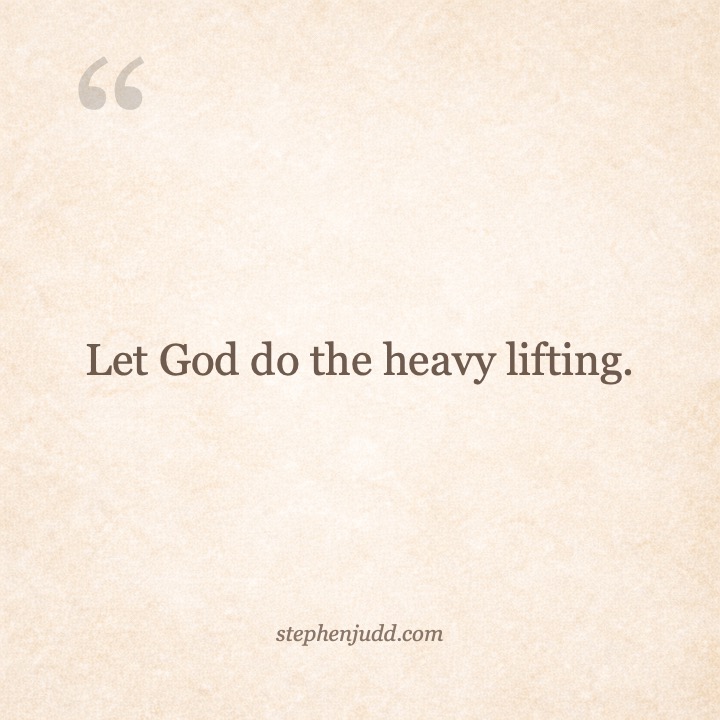
Let God do the heavy lifting.