As the final hours before the crucifixion unfolded, Jesus was betrayed, arrested, falsely accused, mocked, and condemned.
Following His agonizing prayer in Gethsemane, He was taken first to Annas and then to Caiaphas, where He endured false accusations and an unlawful trial. At daybreak, He was brought before Pontius Pilate. Finding no fault in Him, Pilate sent Jesus to Herod, who mocked Him before sending Him back.
Still seeking a way to release Jesus, Pilate offered the crowd a Passover choice: Jesus or Barabbas.
Barabbas was guilty. Jesus was innocent.
Yet the crowd chose Barabbas.
There is a powerful picture of redemption in that moment. Barabbas, the guilty man, walked free while Jesus, the innocent One, took his place.
In a very real sense, we are Barabbas.
We were guilty. We were bound. But Jesus became the sacrifice, and we were set free.
The spotless Lamb of God was about to shed His blood for the sins of the world.
His blood was shed
Matthew records what happened next:
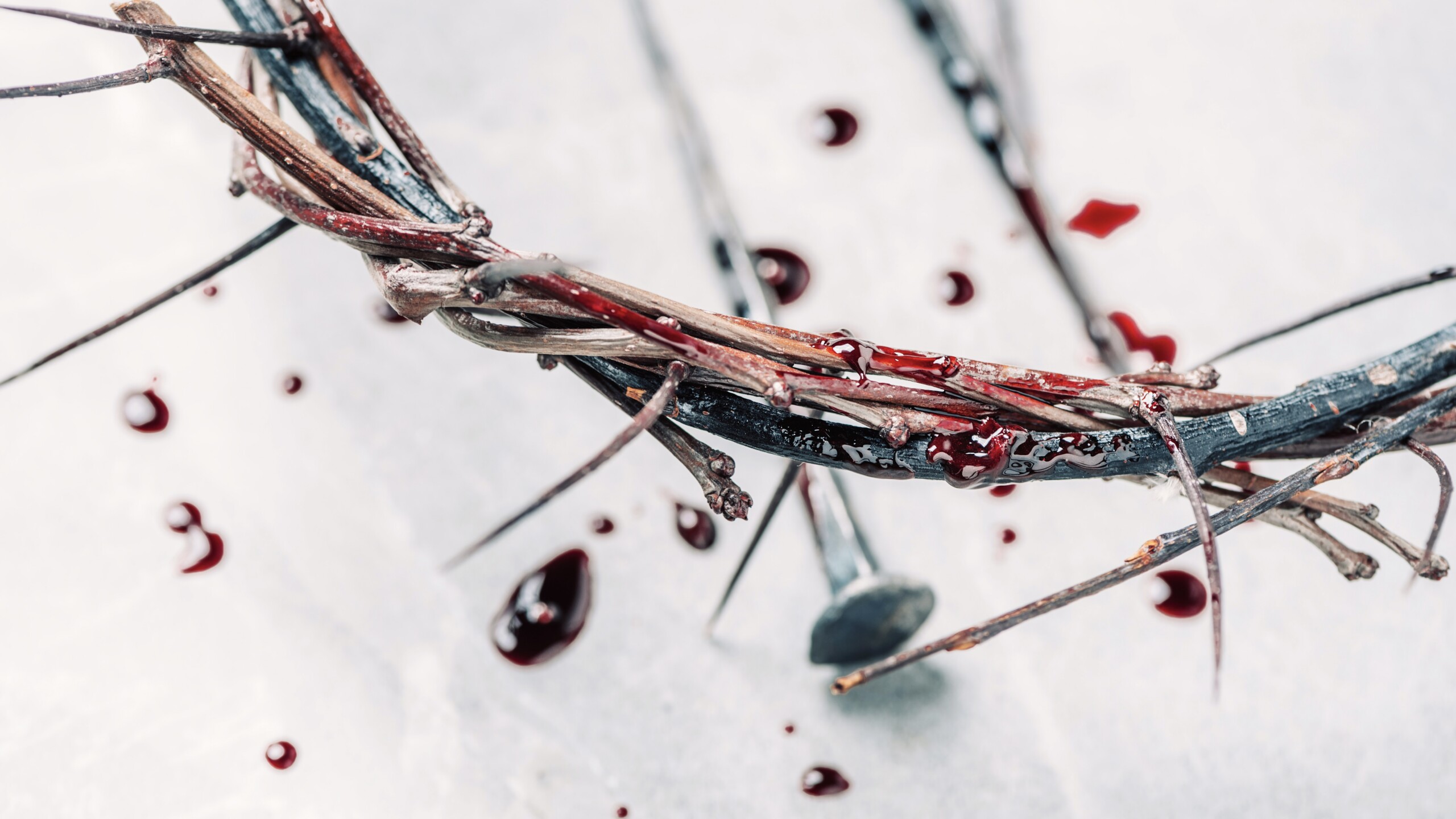
“Then the soldiers of the governor took Jesus into the Praetorium and gathered the whole garrison around Him. And they stripped Him and put a scarlet robe on Him. When they had twisted a crown of thorns, they put it on His head, and a reed in His right hand. And they bowed the knee before Him and mocked Him, saying, ‘Hail, King of the Jews!’ Then they spat on Him, and took the reed and struck Him on the head. And when they had mocked Him, they took the robe off Him, put His own clothes on Him, and led Him away to be crucified.” — Matthew 27:27–31 (NKJV)
It is difficult to contemplate what Jesus endured. We should not sensationalize His suffering, but neither should we sanitize it.
Roman scourging was brutal. Jesus was stripped, beaten, humiliated, crowned with thorns, struck, and spit upon. His suffering was real.
And His blood began to flow.
But His blood was not spilled. It was shed.
Spilled sounds accidental. Shed speaks of intention.
The blood of Jesus was not spilled by chance. It was shed by choice.
What happened that day was certainly a miscarriage of human justice, but behind it was the divine mission of redemption. Jesus was not merely the victim of circumstances beyond His control. He willingly gave Himself for us.
He later said:
“No one takes it from Me, but I lay it down of Myself.” — John 10:18
The blood that flowed from His wounded body was not taken from a helpless victim.
It was given by a willing Savior.
Freely. Lovingly. Redemptively.
Wounded for us
Centuries before Calvary, Isaiah looked prophetically toward the suffering Messiah:
“He is despised and rejected by men,
A Man of sorrows and acquainted with grief.
And we hid, as it were, our faces from Him;
He was despised, and we did not esteem Him.” — Isaiah 53:3
Then the prophet explained why He would suffer:
“But He was wounded for our transgressions,
He was bruised for our iniquities;
The chastisement for our peace was upon Him,
And by His stripes we are healed.” — Isaiah 53:5
He was wounded for our transgressions.
He was bruised for our iniquities.
The punishment that brought us peace fell upon Him.
Isaiah saw the stripes long before the whip ever struck. He saw the wounds before the soldiers inflicted them. He saw the blood before Calvary.
And he understood its purpose.
It was not the blood of a victim. It was the blood of a Savior.
“His blood be on us”
After Jesus had been scourged, Pilate brought Him before the crowd once again. He had repeatedly declared Jesus innocent, but the voices demanding crucifixion only grew louder.
Finally, Pilate washed his hands before them and declared:
“I am innocent of the blood of this just Person. You see to it.” — Matthew 27:24
The crowd answered with words whose significance they could not possibly have understood:
“His blood be on us and on our children.” — Matthew 27:25
They intended those words as an acceptance of responsibility.
Yet there is a profound irony in what they said.
“His blood be on us.”
Those words express the only hope any of us have.
Let His blood be upon us.
Let it cover us.
Let it cleanse us.
Let it redeem us.
The blood they were willing to accept as guilt became the blood God offered for grace.
That is the message of the gospel.
There is a fountain
Some of the great hymns of the church have preserved this truth in language generations of believers have sung.
William Cowper wrote of “a fountain filled with blood, drawn from Emmanuel’s veins.”
Robert Lowry asked the question every sinner ultimately must answer: What can wash away my sin?
His answer was simple:
Nothing but the blood of Jesus.
These songs have endured because they express something much deeper than poetry. They declare the theology of redemption.
There is a fountain.
And everything we need is found in what Jesus accomplished through His blood.
A fountain of life and forgiveness
Long before Calvary, God established a fundamental principle:
“For the life of the flesh is in the blood, and I have given it to you upon the altar to make atonement for your souls; for it is the blood that makes atonement for the soul.” — Leviticus 17:11
The Old Testament sacrificial system pointed forward to a greater sacrifice that was still to come.
Jesus became that sacrifice.
Paul wrote:
“In Him we have redemption through His blood, the forgiveness of sins, according to the riches of His grace.” — Ephesians 1:7
Redemption carries the idea of being released by the payment of a price. We were enslaved by sin and unable to free ourselves.
Jesus paid the price.
The cross was not merely about death. It was about deliverance.
Through His blood, forgiveness is available to every person who comes to Him.
A fountain of cleansing
Forgiveness is wonderful, but the promise goes even further.
John wrote:
“The blood of Jesus Christ His Son cleanses us from all sin.” — 1 John 1:7
The blood does not merely forgive. It cleanses.
It does not merely pardon. It purifies.
David understood the need for that kind of cleansing when he prayed:
“Purge me with hyssop, and I shall be clean;
Wash me, and I shall be whiter than snow.” — Psalm 51:7
David had failed miserably, yet he knew that God’s mercy was greater than his failure.
That Old Testament imagery pointed toward the gospel. The deepest stain of sin could one day be washed clean through the sacrifice of Jesus Christ.
No failure is beyond His grace.
No stain is beyond His cleansing.
No past is beyond His redemption.
The fountain still flows.
A fountain of peace and access
Sin did more than make us guilty. It separated us from God.
But Paul wrote that Christ made “peace through the blood of His cross.” — Colossians 1:20
The cross accomplished what we could never accomplish for ourselves.
It reconciled us to God.
And because of that reconciliation, those who once were far away have been brought near:
“But now in Christ Jesus you who once were far off have been brought near by the blood of Christ.” — Ephesians 2:13
The blood closed the distance.
We do not approach God on the basis of our goodness, achievements, or worthiness. We come because Jesus opened the way.
The cross built the bridge we could never build.
Those who were estranged can come home.
Those who were far away can draw near.
Those who were enemies can become sons and daughters.
A fountain of power
The blood that saves us is also central to our victory.
Revelation declares:
“And they overcame him by the blood of the Lamb and by the word of their testimony.” — Revelation 12:11
There is still power in the blood of Jesus.
Power to overcome.
Power to break the grip of sin.
Power to stand against the enemy.
Power to live in the victory Christ purchased at Calvary.
Christians have sometimes spoken of “pleading the blood.” The expression is not a magical formula. It is a declaration of faith in what Jesus accomplished through His death. Our confidence is not in the phrase itself but in the finished work of Christ.
Years ago, while our family was living in St. Louis, I felt an unusual prompting to go to the front door of our home and plead the blood of Jesus over our family.
I did not know why. I simply obeyed.
That night, a vehicle came speeding down the hill, completely out of control. It tore across our front yard and came within several feet of crashing into the bedroom where our daughter was sleeping.
It stopped short.
I have never forgotten that night.
I believe in praying God’s protection over our families. I believe in placing our confidence in the victory of Calvary. And I still believe there is wonder-working power in the blood of Jesus.
The fountain still flows
From Gethsemane to the judgment hall, from the scourging post to Golgotha, Jesus willingly walked the road that led to the cross.
There He was crucified between two criminals.
He bore not only unimaginable physical suffering but the weight of our sin.
And finally He cried:
“It is finished!” — John 19:30
The price had been paid.
The sacrifice had been offered.
The way had been opened.
Salvation had been secured.
What happened at Calvary was sufficient then, and it is sufficient now.
So the question is not whether the fountain still has power.
The question is whether we will come to it.
Do you need forgiveness? The blood still flows.
Do you need cleansing? The blood still washes.
Do you need peace with God? He made peace through the blood of His cross.
Do you need access to His presence? The blood has opened the way.
Do you need victory? There is still power in the blood.
The blood that was shed was shed for you.
Come to the fountain.
The blood still speaks.
The fountain still flows.
And Jesus is still saving.
Watch the original sermon.
A video of this message is also available on the website.